
New emPLANT degree from academic year 2026-2027
European Master in Plant Breeding and Innovative Plant Sciences
The emPLANT programme has been updated in 2026 to ensure continued alignment with labour-market needs. The programme will also be running for the 2027 cohort . The partner universities have changed, and only a limited number of partial scholarships will be available.
Further details on partner institutions, mobility tracks, and scholarships can be found below.
A full programme description and course curriculum will be published once the updated structure is finalised.
Programme structure
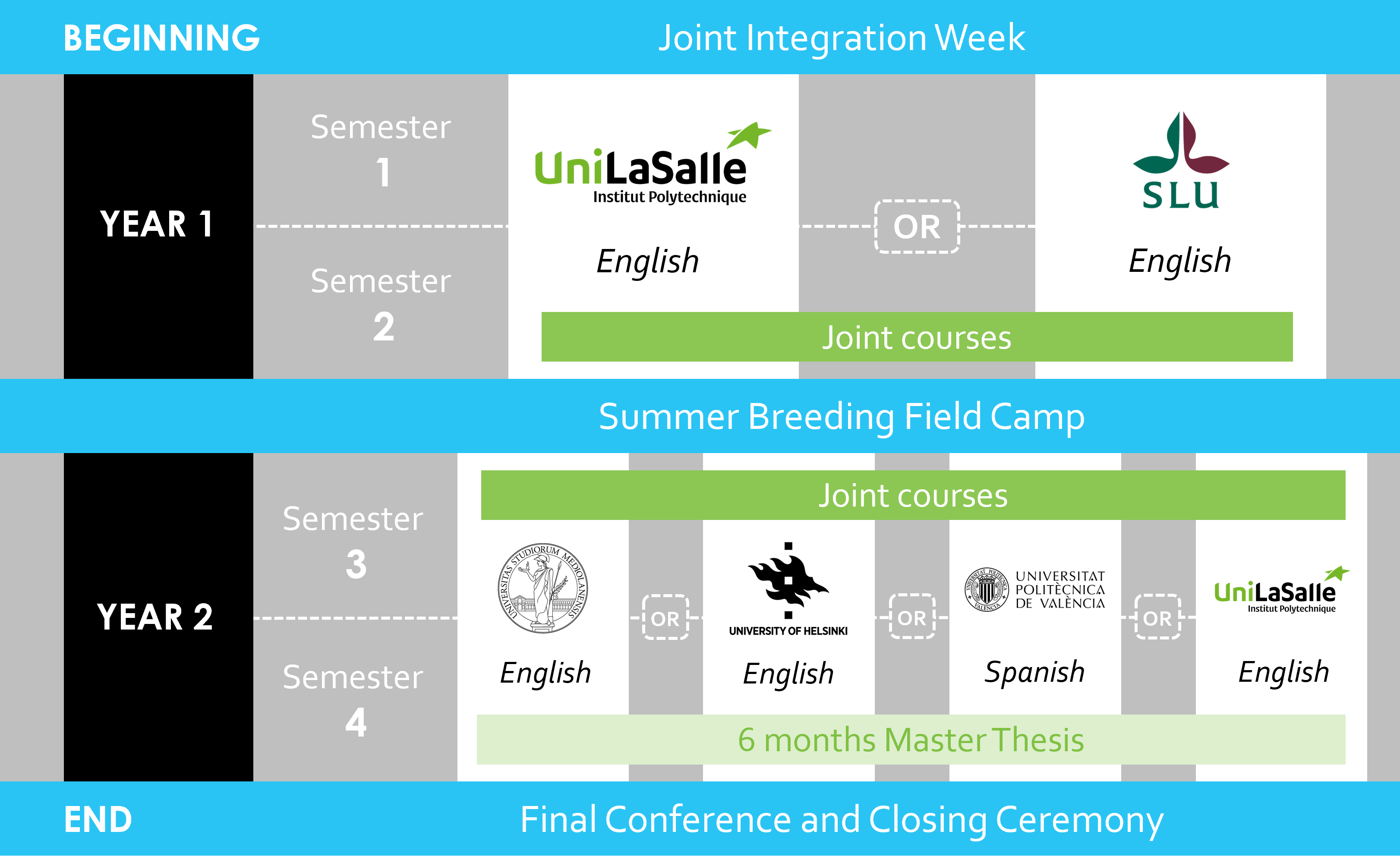
emPLANT is a two year Master Programme of Excellence in the field of plant breeding and data-driven plant innovation, and is composed of the following elements:
- The Joint Integration Week (all emPLANT students together)
- The first year of studies at ULS (France) or SLU (Sweden)
- The Joint Summer Breeding Field Camp (all emPLANT students together)
- The second year of studies at UH (Finland), UMIL (Italy), UPV (Spain) or ULS (France)
- The Final Conference and Closing Ceremony (all emPLANT students together)
Joint courses are taught each academic year.
The complete list of courses will be available soon in the new course catalogue.
The programme structure is as follows:
Preferred mobility tracks and specialisations
The Consortium offers 7 mobility tracks to combine the specialisations and strengths of all partners.
The detailed mobility tracks with the academic profile of each consortium university will be available early-December.
Preferred mobility track is asked in the application form.
Students must be hosted by two different universities of the Consortium and in two different Program Countries other than their own country of residence
First year at ULS or SLU
The two tracks at ULS and SLU are similar and still complementary, setting the basics in terms of plant biology, breeding methods and biotechnological tools:
> ULS:
- The courses introduction to seed business, plant reproductive system and relational databases are unique at ULS
- The education at UniLaSalle is focusing more directly on plant breeding, including plant genetics and practical aspects of plant breeding
- The track at ULS will be more attractive for candidates interested in applied plant breeding and seed business
> SLU:
- Parts of the course plant-microbe interaction are unique at SLU
- Education at SLU is focusing slightly more on basic plant biology, including plant genetics and biology subjects of importance for plant breeding
- The track at SLU will be more suitable for candidates interested in fundamental research and will target students with a high interest in biology
Second year at UH, UMIL, UPV or ULS
The four different tracks at UH, UMIL, UPV and ULS will provide the students with the opportunity to specialise:
> UH:
- Offers you the possibility to select some courses in a panel
- Education at UH has a strong emphasis on molecular breeding and biotechnology. Offer courses in forest tree breeding every two years.
- The track at UH will be more suitable for candidates interested in fundamental research
> UMIL:
- Parts of the course Marketing to breeding and Developing of crop ideotype are unique at UMIL
- Education at UMIL is focusing slightly more on applied breeding
- The track at UMIL will be more suitable for candidates interested in applied research
> UPV:
- Specialization in Horticultural crop trees and vines, biotech adaptation, region-specific breeding
- Courses are in Spanish
- Education at UPV is focusing slightly more on genetic tools
- The track at UPV will be more suitable for candidates interested in fundamental research
> ULS:
- Parts of the courses Seed contracts, Marketing & logistics, Modelization and phenotyping are unique at ULS
- Education at ULS is focusing slightly more on seed production and phenotyping tools
- The track at ULS will be more suitable for candidates interested in applied research and seed business
- An internship made in a company between the first and second year is mandatory
Partial scholarships
Partial scholarships may be granted to the best ranked applicants.
- Some partial tuition fee scholarships may be available. Update on that subject in December 2026: selected students must be able to pay the remaining tuition fees as well as their living and travel expenses in Europe during two years.
- Some partial living expenses scholarships may be available. Update on that subject in December 2026: selected students must be able to pay the remaining living expenses as well as their travel expenses in Europe during two years and the full tuition fees for each academic year.
- Some travel scholarships between Italy and France will be available for students with the following mobility track: ULS-UNIMI
That is why this call for applications is only open to self-funding applicants.
No other scholarships will be available.
All other students will have to pay for the full tuition fees as well as their living and travel expenses during the lifetime of the programme.
Tuition fees for European students: 4500€ per year
Tuition fees for non-European students: 9000€ per year